

Winter cutworm
06/01/2019
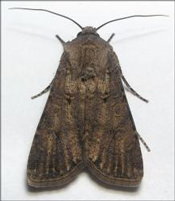 Scientific Name: Scotia segetum
 Type of pest: Arepolyphagous pest
Order: — Lepidoptera
Family: — Noctuidae
Widespreaded in Ukraine in all soil-climatic zones.
The cutworm are multi-species and feed on plants from many botanical families.
The butterfly has a size of 40 - 50 mm. The front wings are brownish-gray (sometimes black) with three distinct dark spots, bordered by a thin black line; the rear - in the male white, in the female - whitish-gray.
Egg size 0,5 mm, ribbed, with flattened base; freshly fermented - milky white, later darkens.
The cutworm of the first three ages are earthy gray or grayish-reddish, matte, of late ages - with a glossy epithelium, along the back of a dark narrow strip; five pairs of abdominal legs, length of a sixth-track caterpillar - up to 52 mm.
The doll is about 20 mm red and brown.
Hibernation cutworm of the sixth age in the soil at a depth of 10 - 25 cm.
Withstand a decrease in temperature to minus 11 ° C.
The success of hibernation depends on the development of the fatty body.
Young cutworm is killed at temperatures below -5 ° C.
With the onset of high spring temperatures, the caterpillar rises to the upper layers of the soil and at a depth of 5 - 6 cm, they are flashed.
The development of puppys lasts 25 - 35 days.
Flying butterflies in the south begins from the middle of April, in the forest-steppe zone - in the third decade of May.
The beginning of the flight and its duration are determined by meteorological conditions of the year. Butterflies are active at night, hiding under the leaves of weeds in the afternoon, as well as in other shelters.
For their development, an additional supply of nectar to flowering vegetation is required.
Eggs are laid on one or small groups on the underside of the leaves and petioles of weeds, on dry vegetable remnants, well-treated soil with liquid vegetation.
On average, one female lays 470 to 2,200 eggs.
In the beet-feeding zone of the first-generation butterflies lay eggs for beets, corn, millet and vegetable crops, and the second generation - for prepared fields for winter crops with non-fossil predecessors.
Embryonic development for the temperature of 28 - 30 ° С lasts for 2 - 5 days, and at 10 - 12 ° С - 24 days.
First-generation cutworm appear at the end of May - in early June.
Depending on the temperature of the air they develop 20 - 60 days.
After feeding, cutworm in the soil at a depth of 1 - 6 cm are converted into a projectile, and after 2 - 10 days - on a puppet.
After 11-14 days, the butterflies of the second generation fly, which lasts about two months; Eggs are usually laid in August, and at the end of the month there are cutworm.
In general, the duration of development of one generation is 50 - 70 days at the sum of effective temperatures 640 - 780 ° C.
In most of Ukraine, winter cutworm develop in two generations, and in the north, and especially in the north-western regions - in one.
The scrupulosity of the winter cutworm is significant. One cutworm of the first generation in one night can destroy 10-15 plants of sugar beet. Second-generation cutworm are most damaging to winter crops. The cutworm can feed on at least 140 species of plants from 36 families.
Reproduction of winter cutworm substantially limits parasites, predators, diseases.
Parasites on the caterpillars: from the family Ichneumonidae - Amblyteles leader W.S., A.panzeri Wesm., Ichneumon sartitorius L., Luteus L. officinalis, Paniscus ocellaris Thoms .; from the Braconidae family - Macrocentrus collaris Spin. and Meteorus rubens W.S .; from taquin - Gonia capitata D. L. and G. ornata Mg., Periscepcia carbonaria Panz., Peletieria rubescens R. D., P. ferina Ztt., Earythia caesia Fll. etc.
Of the birds, the greatest fighters are starling, jackdaw and rook.
Protection measures. Of great importance in limiting the number of winter cutworm is the correct cultivation of soil under winter crops, as well as fields after non-precursors; interrow rotation of soil on crop rotations; Soil cultivation after harvesting of cultivation predecessors of winter crops causes the death of cutworm and pupae.
From biological measures - the use of double-release trichograms at the rate of 50 thousand individuals / ha; from chemical - processing of fields of winter wheat in the presence of two cutworm per 1 m2 insecticides Bi-58, Nurel D.