

Pea beetle (Bruchus)
06/01/2019
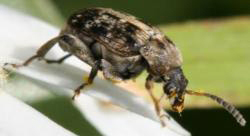 Scientific Name: Bruchus pisorum
 Type of pest: Pest of grain legumes
Order: hardwoods — Coleoptera
Family: grains — Bruchidae
Beetle is widespreaded everywhere. Monophagus. Damaging peas (Pisum sativum, P arvense). Beetle size 4 - 5 mm, black, top covered with reddish hairs; have been cut short, do not cover the two last segments of the abdomen; at the end of the abdomen is a cross-shaped white figure; the front three segments of the antennae, middle legs are reddish.
Egg - 0,6 - 1 mm, elliptical, yellow. Larva length 5 - 6 mm, small head deeply drawn into the thoracic body; pupa - 4 - 5 mm, light yellow.
Hibernate beetles in grains at repositories.In the south of Ukraine, much of them hibernate in the scions of straw, among the plant remains, under the bark of trees and in the soil. The mass yield of beetles from peas is observed at a temperature of 26 - 28 ° С, at 20 ° С - the output is more stretched in time, at 15 - 16 ° С and below - weak.
Higher humidity accelerates the yield of beetles from grains. Overwintering beetles appear in May, concentrating in gardens, on flowering cheremots (along the edges of forest bands), on weeds.
On a plantation of peas fall together with sown seeds but most of them flock out of wintering places. The increased number of beetles on fields is observed at the end of May, in the phase of formation of mustache, and especially during the appearance of buds and at the beginning of flowering. Beetles feed on pollen and petals of flowers.
Beetles are active in hot weather (at a temperature not less than 21 ° С), in the dark days, as well as in the morning and evening, hide in the flowers of peas or among the young, leafy leaves. Fields begin to populate from the edges, gradually covering the entire area. Seizure of eggs is observed from the first decade of June in the steppe, from the middle of June - in the forest-steppe zones.
Each female lay eggs on top of the beans. The beginning of laying eggs is observed at a temperature of 18 ° C, the mass - at 26 - 27 ° C. The fertility of each females is from 70 to 220 eggs. The eggs are clearly visible on the green background of the bean. Embryo development of eggs lasts 6 to 10 days.
After the revival of the larva, the bean's wall disappears, then the tissue of green, often undeveloped, grain, in which the further development of the larva, pupae and beetles of the new generation takes place.
The grain able to penetrate several larvae but only one survives. In the forest-steppe zone, the development of the larva occurs during 36 - 37, pupa - 25 days, in the steppe zone - respectively 29 - 36 and 13 - 18 days.
The optimum temperature for development of larvae and pupae is 26-28 ° С, at 10-12 ° С development is discontinued. For a complete development cycle of pea grains a sum of effective temperatures is required 516 - 640 ° C.
For optimal harvesting time of peas (in July), only larvae are found in grains, in August - pupae
and beetles. The pest develops in one generation.Damage to grain leads to a decrease in its mass, quality and similarity. In the excrements of the larvae, there is an alkaloid cantharidine, so the damaged grain can not be used for food and forage cattle. Near the grain of peas there is a grain of peas southern - BruchusemarginatusAll., Which occurs in the Crimea and harms peas, nut and ranks.
The number of pea grains reduce oocytes: Lathromeris bruchocida Vis., Which in some years can destroy up to 60-70%; Uscana senex Grese, on parasite larvae Triaspis thoracicus Cuzt., Eupteromalus leguminis Gah., Brichicida orientalis Crawf., Uscana semifumipennis Gir., Microdontomerus anthomoni Crawf. etc.
In the period of storage of grain, larvae, pupae and beetles destroys pussy mite - Pediculloides ventricosus Newp.
Protection measures. Adherence to crop rotation.Timely harvesting and peeling of peas, early plowing fields. Seed peas fumigation with authorized drugs when grains are infected with 10 seeds per 1 kg with a moisture content of not more than 15.5%. Spraying of seed and fodder crops of peas with insecticides Fastak, Bi-58 in the phase of budding - the beginning of flowering against pea grains in the presence of 10 beetles per 100 bark vomit or 10 beetles per 100 plants.