

Colorado potato beetle
06/01/2019
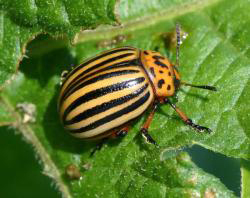 Scientific Name: Leptinotarsa decemlineata
 Type of pests: Potato Pests
Order: coleopterus — Coleoptera
Family: Chrysomelidae
Widespreaded everywhere. Damages potatoes, tomatoes, eggplants, peppers and other pastels. Beetle size 8 – 12 mm, yellow or reddish-yellow. The body is short-haired, strong, convex, brilliant; on the wings of ten black stripes. Egg size 0.8 - 1.4 mm, reddish, shiny, long elongated. The pupa is up to 10 mm, the younger is dark-skinned, the elder is red-haired (brick-colored), the body is sticky, fleshy, scaly, convex on the top, flaky from the bottom, especially bloated in the middle part, covered with liquid bristles. The Pupa - 10-12 mm, orange-yellow or reddish.
During winter imago is in the soil, often at a depth of 10 - 30 cm. In areas with sandy, sandy and other light soils, wintering occurs at a depth of 30-40, sometimes up to 50 cm. During wintering a significant part of the dying - up to 42% of wintering people on depth up to 10 cm. In case of occurrence in the soil at a depth of 20 - 30 cm, about 13% die, and at a depth of 40 - 50 cm - only 0,2% of the imago. Part of the population after breeding may be winter for the second time. In Polissya and Forest-steppe, for the second winter, 18-20% of the entire population goes, and in some years much more. Thus, the wintering population is composed of both the imago of the first year, and partly of the imago of the second year of life. In the spring, these imago normally feed, lay eggs and die only in late June - in July.
The terms of the spring awakening of the Colorado potato beetle are largely dependent on weather conditions, especially on soil temperature and rainfall. The most intense their yield is observed after rain falls, in warm sunny weather, at a temperature of not less than 15 ° С and a ground - 13 - 14 ° С. Such conditions in the Polissya and Forest-steppe of Ukraine are most often formed in the third decade of May, and in the southern regions - from April 10 to May 10. Exit imago from the ground is stretched for 1 - 1,5 months. The mass exodus of the overwintering imago coincides with the beginning of laying eggs with the first beetles that appeared on the surface of the soil.
Exit of wintering places and their duration depend on the physiological state of insects. The first appear on the surface of the physiologically weakened imago, twice winters, reborn from the first masonry of eggs. They die a lot after the exit and during the summer they are characterized by reduced fertility. The most life-saving is the massive imago. For some time they are kept on the surface of the earth, then, in 2 - 3 days, young leaves of potatoes begin to eat. Imago settle on seedlings of tomatoes, eggplants, peppers, sometimes picking up on potatoes, satiating it with little children and tubers. In search of food beetles fly over long distances. Often, they are harvested in large quantities on independent potatoes of admixture areas, where stairs appear earlier than in field fertilizers. They also feed on wild plants - blackberries, blueberries, pastels, dumpling and other passion crops.
On the 3rd - 5th day after leaving the soil, the imago mates, and the females begin to lay eggs on the underside of the leaves in small groups, 28-30 and sometimes up to 70 in each laying of the eggs. High-females produce an average of 900 to 1600, and in some cases over 2000 eggs, lining them during the summer. Embryonic development lasts from 6 to 18 days, depending on the temperature regime and humidity of the air. The optimum for the development of embryos is a temperature of 20 - 22 ° С and a relative humidity of 65 - 70%. Under such conditions, the revival of larvae begins at 5 - 6 days after laying eggs. At temperatures below 12 ° C, embryonic development does not occur. The larvae feed on open leaves on potatoes and other pastels for 18 to 24 days, in southern regions and in the lower part in West regions- for 14 days.
Immediately after leaving eggs, larvae feed on egg shells, and sometimes eat eggs containing live embryos. Then they gnaw the leaf mold from the bottom, gradually move to the top side and scoop the leaves completely, leaving only the veins. During the life of the larvae, they lick three times and have respectively four centuries. The most aggressive larvae of the older ages. At temperatures above 12 ° C, they feed on day and night. Having destroyed leaves on one plant, they move to others. Having completed the development, the larvae are deepened to 8 - 10 cm (sometimes up to 20 cm) soil for dragging. The development of the pupa lasts for 12 - 21 days.
Young imago of the first summer generation begin to appear in the forest-steppe zone in the third decade of July, and in the Steppe regions - in late June - in early July. Much of the young imago in the current year does not lay eggs at all, but goes to the soil for wintering. Next year, this part of the imago breeds very actively and creates the greatest threat to the crop.
Postponing of eggs of the first summer generation in Polissya and Forest-steppe is observed at the end of July - in early August, and in the south of Ukraine - almost a month earlier. First-generation females: minimum 130, maximum - 400 eggs. In the southern regions and the lowland part of Transcarpathia, the larvae end up feeding, pounding, and the second generation imago comes out of pupae already in the second half of August. Sometimes after a short supply they give rise to the optional third generation, which completes, however, its development only in some years.
Characteristic biological sign of the Colorado beetle is the presence in the cycle of its development of several forms of physiological rest of different lengths, which complicates the struggle with it. In Ukraine, there are six categories of physiological rest, which are very important when interacting with environmental factors in different periods of the year: 1) winter diapause, which lasts from two to four months per year, which saves the cost of the body of substances stored in a warm time. the end of summer and autumn to the onset of cold; 2) winter hibernation, which changes the diapause of winter on the dawn of the cold season; it lasts until early spring; At that time, the processes of restoration are carried out before the onset of spring awakening; 3) summer diapause, physiologically close to winter, observed in the part of the population in the summer, in the hottest period that lasts a month; 4) summer "dream", which covers a significant part of the population in the middle of summer and lasts up to 10 days; 5) protracted (perennial) diapause, which in the soils of light mechanical composition lasts for the proportion of persons under the age of three years and ensures the preservation of the species in periods unfavorable to an active life of more than one year; 6) repeated diapause, which falls at the end of August - in early September wintering the imago, multiplied in the summer and lived until autumn. These adaptive phenomena predetermine the constant presence of the imago in the soil in proliferative multiplication cells. The natural extinction of the overwintering imago occurs gradually, throughout the summer season, rising from spring to autumn. In the limited number of Colorado beetles, its natural enemies - predators, parasites and entomopathogenic organisms - play an important role.
Protection from pest. After harvesting or processing - cultivate the soil with the choice of the remaining tubers, to prevent the emergence of loneliness, which is the reservation of the Colorado potato beetle; fertilizing and feeding, timely loosening, hanging and skipping for increased potato resistance; mowing the hedge before assembly. When populated with larvae and beetles, 10% of plants of potato crops are sprayed once or twice with insecticides. Anti-larvae are effective abiopreparations.