

Eurygaster integriceps (Puton)
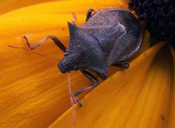 Scientific Name: Eurygaster integriceps
Type of pest: Pests of cereal crops
Order: — Hemiptera
Family: — Scutelleridae
In Ukraine, beetle is widespreaded in the southeast of the forest-steppe and the Steppe.
It damages wheat, barley, rye, oats, corn, sometimes sunflower and beets.
The body of the imago is wide-oval, length 9 - 13 mm, width 6 - 7 mm; color from light brown or light gray to dark gray, in some years of black color.
The head is triangular, the wicker plates and the casing end on one level with its front part. The lateral edges of the anterolary regions are round and convex.
Egg length 1 mm; freshly deposited - green, then darkens, for 5 - 6 days a noticeable embryo becomes in the form of anchor-like picture.
The larva of the first age is black, the size is 1.3-1.5 mm, the second - with a light abdomen, head and chest dark, in the size 2 - 2.3 mm; the third - gray, with the rudiments of the wings, 5 - 6 mm; the fifth - straw color, 8 - 10 mm
During the year one generates over one year, wintering in an adult condition under fallen leaves, in stripes and forests, and rarely in gardens and other tree plantings. For wintering, it selects light and well-ventilated areas with low soil moisture and loose litter.
In field-protected forest strips, bugs are concentrated on the southern and eastern sides.
In the spring, when the litter is warmed to 12 - 14 ° C, the bugs are woken up, and at the temperature of 16 - 17 ° C appear on its surface.
A mass flight of them on wheat crops begins when, during 3 - 5 days, the daily temperature reaches no lower than 18 - 19 ° C.
The males begin to flee first, then the sexual ratio is aligned.
A ratio of 1: 1 is a diagnostic sign of the completion of the bug migration on the fields (MP Secun, 2002).
After flying on grain cereal crops in the cool days of the bugs live in the lower tier of sableworm, hiding in the nesting areas, in cracks and under the lumps of soil.
In sunny and warm weather at temperatures above 18 ° C they are active and cause significant damage, damaging the plants in phase tillering and stem elongation.
Punishing the proboscis stem below the ear of the ear, the bugs suck the juice of the plant.
In the place of the injection, a constriction occurs, the damaged stems remain green for a long time, but do not cure and gradually die.
When pricked at the core of the ear, which is located in the leaf of the spine, white colossal occurs above the injection site.
After 5-12 days after the flight and the enhanced feed begins laying eggs.
Females lay them in two rows, more often than 7 in each, on leaves of cereals, various weeds, stems, plant remains, lumps of soil.
The period of laying eggs lasts 40 - 50 days.
One female can delay 200 - 350 and more eggs.
Body developing is observed in years preceding two three years with the early stages of the release of bugs from winter and favorable conditions for laying eggs and the development of larvae.
Depending on the meteorological conditions, the number of eggs can vary substantially, during the years of mass reproduction 60 - 80%, and during depression - up to 10 - 20% of the total egg production.
After 6 to 20 days from eggs, larvae that do not feed on the first lynx are reviving.
Feeding them with vegetative and generative parts of cereals begins with the second age.
The greatest damage is caused by the larvae of older ages and new generation bugs, their cycle can only be completed with grain feed.
The duration of development of larvae is 40 - 50 days. Young bugs during 8 - 14 days intensively feed on grain for the accumulation of nutrients in the body (M.P Secun, 2002).
In the range of the bugs everywhere develops in one generation.
Migration is a characteristic feature of the life cycle of this pest.
By their intensity, distinguish migration and sedentary types of populations (M.P Secun, 2002). The first of them is distributed in the Crimea. During migration, its individuals usually overcome significant (150 - 200 km) distances from wintering to grains and back. The sedentary populations are characterized by short (20-50 km) flights from wintering areas to crops (M.P Secun, 2002).