

Sugar Beet leaf aphis
06/01/2019
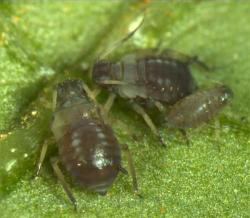 Scientific Name: Aphis fabae
 Type of pest: Sugar Beet Pest
Order: — Homoptera
Family: — Aphididae
Beetle is widespreaded everywhere, especially numerous in the western regions. Polyphage. In addition to beetroot damage to beans, cattle, pumpkins and other crops and weeds.
Covered parthenogenetic female length 1.8 - 2.5 mm. Has an oval body, black with greenish-brown tint, covered with a weak wax bloom; breast and legs are pale-yellow; caudal and black-tailed legs; the proboscis reaches the middle leg basins.
Winged female size 1.4 - 2.0 mm; head and chest black, shiny; abdomen black-green, front hips white, black mustache. Amphiphon female - 2.2 - 2.7 mm, wingless, blackened or mat-green, in a sip gun; around the juice tubes and reddish pigment between them; the hind legs are black, the tail is conical.
Male size 2 - 2.5 mm, winged, with black abdomen, big eyes, long legs and mustaches. Egg 0.5 - 0.6 mm, long elongate, just deposited - yellowish green, later black, brilliant.
Migration type. Hibernate eggs on shoots near the basis of the kidneys (Evonomus europaeus), (E. verrucosa), (Viburnum opulus) and (Philadelphus coronarius).
In April, at an average temperature of 7 - 9 ° С, wintering eggs revive larvae, which, after 12-14 days, feed on buds and turn into uncreated female.
The females reproduce parthenogenetically, regenerating every day from 5 to 8 larvae, an average of 50 - 70. The primary fodder plants develop 3 to 4 generations of aphids - until the growth of the bushes is completed.
At the end of May - in the beginning of June, there appear winged parthenogenetic females, which are scattered in search of intermediate herbaceous plants and, in particular, sugar beets. The appearance of females and their migration are caused by the deterioration of the quality of the feed due to the overhead or drying of shoots in the bushes.
Migration is complete and partial, in which part of the aphids is in the primary owner all season, until the appearance of the amphigonal generation. First of all, aphids populate beet-plantings, which earlier than beets of the first year begin their development.
On beetroots and other herbaceous plants, aphid quickly replenishes parthenogenetically until autumn, giving during this time 8-10 and more generations of wingless aphids.
Thanks to the latest aphids, it quickly spreads around the culture.
At a temperature of 23 - 28 ° С and relative humidity of air no less than 60 - 80% of one generation develops for 10 - 14 days.
The largest population of plants is usually in the first half of July.
The aphids earns juice from the leaves, popping them from the bottom. The damaged leaves are deformed, twisted in the longitudinal direction, then it fades and dries. Significant damage to the aphids causes the seeds of sugar beet, which, in addition to the leaves, damage shoots, which leads to their distortion. The act of earning is accompanied by the release of salivary enzymes, which, when they enter the tissues of plants, cause plasmolysis of cells and convert starch to sugar.
Damaged plants have been in a painful condition for a long time due to poisonous effects of salivary enzymes even after the destruction of the pest. Damaged plant lags in growth, its sugar content decreases (up to 0.7%) and the mass of root crops (up to 30%), seed output decreases and its quality deteriorates. Often the aphids are the carrier of a viral disease - a mosaic of beets.The number of aphids is limited by many predators and some insect parasites.
Imago and larvae feed on - Aphidoletes aphidimyza Rd., - Paragus tibialis Flln., P. bicolor Fabr., Sphaerophoria menthastri L., S. scripta L., Metasyrphus nitens Zett, M. latifasciatus Meg.
The aphids are infected - Aphidius matricariae Hal., Trioxys auctus Hal., T. heraclei Hal., Lysiphlebus confusus Tremb., L. fabarum Marsh., L. gracilis Frst., Phygadeuon fumator Graw., Ph. subtilis Graw., - Aphelinus humilis Merc., A. chaonia wek. etc.
Protection measures. Destruction of weeds. Limitation of planting of grass, jasmine. When more than 5% of plants are hunted in May, more than 10% in June and more than 15% in July, crops must be treated with insecticides. However, if the ratio of the pest: the predator is 20 ... 30: 1, the use of insecticides is inappropriate.